
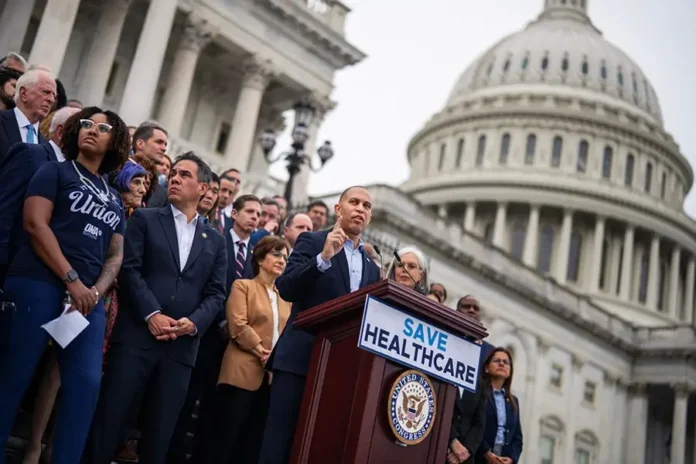
As the U.S. government enters a prolonged shutdown, Democratic lawmakers are placing healthcare front and center in their messaging and legislative strategy. What once might have been a background policy issue has now become a linchpin in their public narrative—partly as leverage, partly as a moral appeal, and partly as electoral positioning. With negotiations stalled and pressure mounting, the question is whether this emphasis will pay off politically or backfire under scrutiny.
In this article, we examine how Democrats are wielding healthcare in the shutdown fight, what risks and opportunities they face, and how the public is reacting.
Why Healthcare Became the Focal Issue
Expiring ACA Subsidies: The Spark
At the heart of the standoff is the impending expiration of expanded tax credits under the Affordable Care Act (ACA), which have helped many Americans lower their health insurance premiums. Democrats argue that letting these credits lapse would raise costs dramatically for families—something they fear Republicans are willing to accept.
By tying funding talks to the extension of these subsidies, Democrats hope to force Republicans to either concede on a popular benefit or absorb the political backlash. It’s a high-stakes gambit: on one hand, it can frame Democrats as defenders of everyday people’s health; on the other, they risk being painted as obstructionists if the shutdown drags on.
Political Terrain & Messaging Advantage
Healthcare has long been an issue where Democrats tend to fare better in public opinion, especially in framing Republicans as threatening guts to protections or making care less affordable.
In this shutdown cycle, polling suggests that many Americans already blame Republicans for the impasse. Democrats see an opportunity to reinforce that narrative by making healthcare the headline story. A memo circulated by a Schumer-aligned PAC even urged party members to “keep the pressure” and suggested Democrats are winning the narrative war.
The strategy hinges less on getting perfect legislative wins immediately, and more on shaping public memory and framing. If the electorate associates a disastrous cost hike in health premiums with Republican inaction, it could shift blame and political capital.
How Democrats Are Executing the Strategy
Legislative Maneuvers
Democrats have repeatedly blocked continuing resolutions (CRs) passed by Republicans, arguing those bills lack the needed ACA subsidy extensions.
Instead, they propose alternative versions of CRs that include healthcare provisions—specifically, a renewal of the enhanced tax credits. But these versions haven’t secured enough Republican support to pass.
In debates and committee sessions, Democratic lawmakers emphasize that budget talks without healthcare amounts to “opening the lights but shutting out coverage.” They use examples of individuals who stand to see dramatic premium increases next year.
Public Messaging & Media Strategy
Democrats are deploying health care stories heavily in media appearances, press releases, social media, and local town halls. They’re spotlighting how many Americans will be impacted by premium increases, using personal narratives to humanize the policy stakes.
They’re also pushing Republicans to take public stances on the healthcare elements—forcing GOP lawmakers to defend whether they support or oppose the subsidies. That makes Republicans own the optics of healthcare losses, rather than letting them dodge accountability.
Meanwhile, they challenge GOP claims that Democrats are shutting down the government for healthcare, instead framing Republicans as risking care by refusing to bargain. Fact checks have already flagged several Republican claims (e.g. that Democrats are trying to grant free health care to undocumented immigrants) as misleading.
Challenges & Risks in the Strategy
Public Patience & Shutdown Fatigue
One vulnerability: even voters who sympathize with preserving healthcare subsidies may grow weary of a protracted shutdown. Essentials like national parks, federal services, and public safety begin to suffer—leading to frustration that can turn on political players, whoever is seen as obstructing resolution.
If Democrats are viewed as too inflexible or holding healthcare hostage to broader funding, opponents may portray them as engaging in political brinkmanship at the expense of functioning government.
Mixed Poll Signals
While many polls show support for extending the ACA subsidies, fewer show willingness from voters to support a shutdown to obtain that extension. Some recent surveys indicate a plurality might prefer Republicans accepting the subsidies separately and reopening government.
If Democrats can’t convincingly make the case that the shutdown is part of the health care battle, the issue may weaken as the shutdown drags on.
GOP Counter-Messaging & Defensiveness
Republicans are attacking Democrats with claims that the strategy is purely political theater, or that Democrats are pushing for expensive expansions not backed by funding. Some GOP voices argue Democrats are manufacturing a fight.
Moreover, the White House and GOP officials have criticized Democrats for “using health care as a cudgel” in the budget fight.
If the GOP can reframe healthcare arguments as wishful spending or as forcing excess burden on taxpayers, it could undercut the emotional appeal.
Legislative Complexity & Negotiation Constraints
Even if Republicans agree to restore subsidies, fine print disagreements can derail deals (eligibility changes, caps, budget offsets). Healthcare policy is full of tradeoffs, and Democrats must negotiate carefully or risk unpleasant compromises.
Additionally, procedural hurdles in Congress (filibuster, budget rules, House-Senate reconciliation) make sweeping health policy changes in a shutdown window difficult to pass cleanly.
What to Watch in the Coming Days
- Senate Votes & CR Amendments
Watch whether any of the Republican CRs are amended to include healthcare subsidy extensions, or whether Democrats push their own amended CRs. Vote counts will show where moderates or soft Republicans may break. - Polling Shifts
Pay attention to whether support for Democrats’ posture holds or erodes as the shutdown lengthens. Shifts in blame attribution will matter deeply in November 2026. - Premium Announcements & Insurance Rates
As insurers begin to publish next year’s premiums, any early evidence of large jumps in pricing will provide fodder to Democrats’ arguments. - Media & Local Reaction
How voters in key states perceive stories about losing health subsidies or rate hikes could become critical in close districts. - GOP Messaging & Concessions
If Republicans start offering half-measures—e.g. modest extension of subsidies—they may try to peel off support or undercut Democrats’ negotiating leverage.
Strategic Paths for Democrats
- Stay Firm, but Show Willingness to Negotiate
Democrats will aim to avoid the appearance of inflexibility while not conceding on core healthcare demands. - Incremental Offers & Safe Compromises
If full extension is blocked, Democrats might consider shorter subsidy extensions, tighter eligibility, or phased rollouts to break the logjam without losing face. - Highlight Real People & Real Harm
Continued storytelling will help ground policy in human impact—making the case that this is not abstract politics but the cost of insurance coverage. - Frame Fallout as GOP Responsibility
By continuously tying harm (lost coverage, premium hikes) to Republican inaction, Democrats hope the political burden shifts. - Plan for Split Messaging in Midterms
Even if partial compromises emerge, Democrats may use the shutdown as a platform to rally base support around health care for 2026.
Conclusion
Democrats have strategically elevated healthcare into the central wedge in the shutdown battle. Instead of letting budget line items dominate, they are staking their credibility and messaging on protecting insurance subsidies and preventing premium hikes.
This approach has built-in strengths: healthcare is visceral, people relate to it directly. It allows Democrats to vividly illustrate what’s at risk if political gridlock wins. But it also carries danger: drawn-out shutdowns, messaging fatigue, and concessions could erode public support or give Republicans openings to flip the narrative.
In the unfolding standoff, the party that successfully frames who’s hurting and whose plan is fair will likely win not just a temporary negotiating victory—but long-term positioning for voters in the months ahead.